Each year, Victoria’s public health services formalise their commitments through the Statement of Priorities (SoP) process. While the SoP is a critical accountability mechanism, the real leadership challenge is not simply agreeing what will be delivered. It is creating the organisational conditions that make delivery possible.
For boards, executives and senior leaders, the SoP brings into sharp focus a broader question facing many complex organisations:
How do we translate strategic commitments into practical, sustainable performance?
Across our work with health services, government agencies and other organisations that deliver complex services, we consistently see that high performance is rarely the result of strategy alone. It depends on the alignment between priorities, governance, culture, leadership and operating model design.
The organisations that perform well do not leave delivery to chance. They deliberately create the conditions that allow people to understand the priorities, make good decisions, work across boundaries, manage risk early and stay focused on outcomes.
Five Conditions That Enable Performance
- Strategic clarity that reaches every level
Strong organisations make strategy practical and meaningful. Effective leaders do not assume that because priorities are clear at board or executive level, they are understood across the organisation.
This requires more than cascading information through documents and emails. It requires storytelling. Leaders need to explain the connection between strategic commitments, service outcomes, staff experience and the communities they serve. A meaningful story about strategy helps people understand and connect not just to what the priorities are, but why they matter and how their work contributes.
Practical ways to create this condition include:
- Translate strategic commitments into a small number of clear organisational priorities.
- Develop a simple strategy story that leaders can consistently use across the organisation.
- Cascade priorities through business plans, team plans and individual objectives.
- Use plain language that explains what matters, why it matters and what will change.
- Equip middle managers to tell the story in a way that is relevant to their teams.
- Regularly connect operational decisions back to strategic commitments.
The test is simple: people should be able to explain how their work contributes to what the organisation has committed to deliver.
- Governance that creates visibility, not just oversight
Effective governance does more than receive reports. It creates early visibility of risk, progress and performance.
Practical ways to create this condition include:
- Agree what information the board and executive need to see early.
- Focus reporting on risks, decisions and trade-offs, not just activity.
- Analyse lag indicators – for example, workforce turnover, patient experience data.
- Interpret lead indicators – for example, roster gaps and vacancy trends, fatigue trends
- Create clear escalation pathways when delivery is off track.
- Build regular conversations between governance, executive and operational leaders.
Good governance helps leaders act while there is still time to influence the outcome.
- Integrated workforce and financial planning
Workforce and financial sustainability cannot be treated as separate planning exercises. Most delivery risks sit at the intersection of capability, capacity and cost.
Practical ways to create this condition include:
- Bring finance, workforce and operational leaders together in planning discussions.
- Test whether workforce plans are affordable and whether financial plans are deliverable.
- Identify critical roles, capability gaps and pressure points early.
- Use scenario planning to test different workforce and funding assumptions.
- Make explicit decisions about what can be delivered within available resources.
This is where strategy becomes real. Organisations must be honest about what they can deliver, what needs to be sequenced and where trade-offs are required.
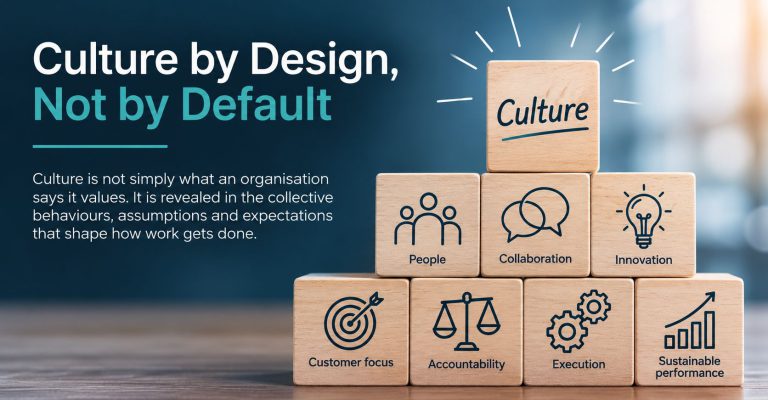
- A culture that balances care and accountability
Sustainable performance requires both care and accountability. In health services, care is often deeply embedded in purpose and professional identity. The challenge is ensuring this is matched with clarity, ownership and constructive performance conversations.
Practical ways to create this condition include:
- Define what accountability looks like in everyday leadership behaviour.
- Clarify who owns each priority, decision and deliverable.
- Build leader capability in feedback, coaching and difficult conversations.
- Normalise regular performance conversations before issues escalate.
- Recognise leaders who demonstrate both empathy and follow-through.
The goal is not a harder culture. It is a clearer one.
- An operating model designed for delivery
Structure, reporting lines, decision rights and ways of working either enable delivery or create friction. High-performing organisations regularly test whether their operating model still fits what they are trying to achieve.
Practical ways to create this condition include:
- Review whether current structures support the organisation’s priorities.
- Clarify decision rights across board, executive, senior leaders and teams.
- Identify duplication, bottlenecks and unclear handover points.
- Strengthen cross-functional ways of working around major priorities.
- Align leadership roles to future needs, not just historical arrangements.
An operating model should make it easier for people to deliver, not harder.
Performance Is Built Deliberately
The Statement of Priorities may be the formal mechanism, but delivery depends on the strength of the organisation underneath it.
The organisations that perform well are not simply better at planning. They are better at alignment. They connect strategy to operations, governance to decision-making, workforce to finance, culture to accountability, and structure to delivery.
This is where performance becomes an organisational capability.
At TMS Consulting, we work with boards, executives and leadership teams to strengthen the conditions that enable sustainable performance. Our work spans strategy facilitation, governance effectiveness, leadership development, workforce planning, culture transformation, organisational design and operating model review.
For health services preparing for the next SoP cycle, the opportunity is not just to finalise a document. It is to use the process as a catalyst to ask a more important question:
Are we organised, aligned and equipped to deliver what we are committing to?