Every organisation has a culture.
Whether it has been intentionally shaped or has simply evolved over time, culture influences how decisions are made, how leaders lead, how teams collaborate, and how work gets done.
Yet many organisations struggle to clearly articulate their culture beyond values statements or engagement survey results. Culture is often thought about in abstract and theoretical concepts that are thought to be too complex and difficult to measure. Engagement surveys measure the individual sentiment of employees, which can change day-to-day depending on anyone’s moods as it gauges how people are feeling about an organisation.
Culture is more than what is written on the wall, or how people are feeling. It is the collective patterns of behaviour, attitudes, assumptions, and expectations that shape everyday performance. Culture measures collective, practical behaviours that describe how work actually gets done.
If organisations want to improve performance, navigate change, attract and retain talent, or deliver their strategy, they need to understand the culture they currently have and the culture they need for the future.
You Cannot Change What You Cannot Clearly See
Leadership teams often describe the culture they aspire to create as collaborative, accountable, innovative, customer-focused, and agile.
However, employees may experience something different:
- Decisions escalated unnecessarily.
- Risk aversion limiting innovation.
- Silos restricting collaboration.
- Accountability applied inconsistently.
- Activity valued more than outcomes.
Neither perspective is wrong and both can be right. They reflect different experiences and perspectives on why things happen the way they do.
Defining and assessing a fit for purpose culture helps organisations move beyond assumption and understand the lived reality of how work gets done and if it is aligned with what they are trying to achieve strategically.
Defining and Assessing Culture Creates a Baseline for Change
Culture often determines whether transformation, leadership development, workforce planning, technology implementation, and strategic planning succeed or fail.
A culture assessment can:
- Help organisations define the desired culture
- Identify what behaviours are driving outcomes
- Highlight cultural barriers that are impacting performance.
- Turn the ‘abstract’ into the ‘practical’ and measurable.
Without a baseline understanding of both the target culture, the current culture and the gap organisations risk addressing symptoms rather than causes.
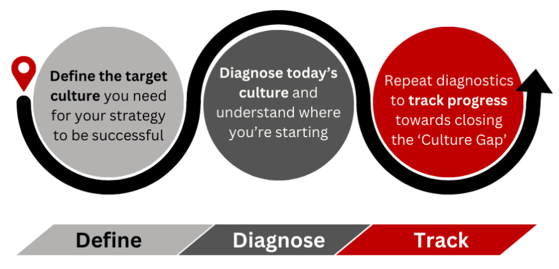
At TMS Consulting, we work with organisations to clearly articulate culture so leaders can make informed decisions about the behaviours, systems and ways of working needed for the future. We do this by breaking culture down into observable behaviours, using the Culture15 framework, enabling organisations to measure and manage culture at a practical level and in common business language that makes sense.
The culture15 framework assesses culture across15 behavioural axes, grouped into 5 key behavioural domains; the 15 axes of behaviour are measured via scaled ratings, for example; People Interactions can be rated from being Harmonious to Challenging. Decision Making can be rated from Democratic to Hierarchical. The framework defines the culture through measuring specific behaviours aligned to how the work gets done, such as how meetings are run and how decisions are made.
Contact TMS Consulting to discuss how we can help you assess and articulate your culture.